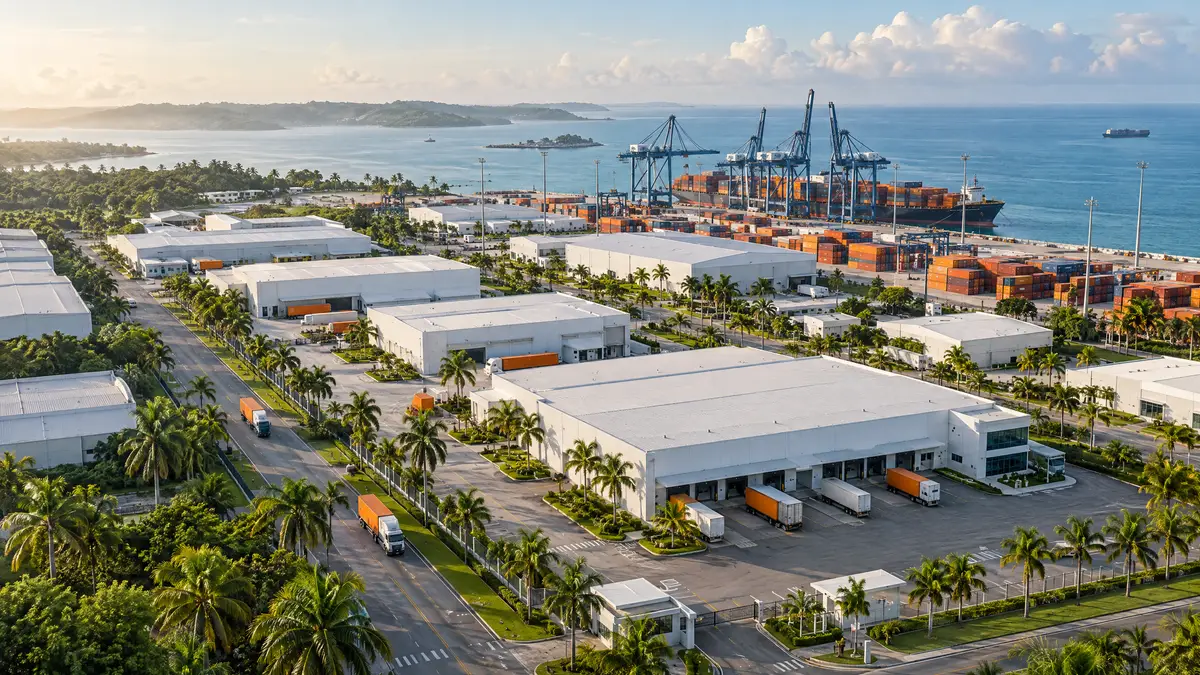
The Colon Free Zone (ZLC, for Zona Libre de Colon) has operated since 1948 in the province of Colon, Panama. It is the second largest free trade zone in the world after Hong Kong. More than 2,500 companies move close to USD 25 billion a year through it, mostly toward Latin America. For an Ecuadorian importer, the ZLC can be the difference between waiting 45 days and having cargo ready in 5.
What the Colon Free Zone actually is
The ZLC is a special customs regime where goods come in, are stored, reconditioned and shipped out without paying taxes in Panama. They are taxed only when they enter the Panamanian market or when they are re-exported to another country. For an importer in Ecuador, ZLC purchases are treated as Panamanian origin if the goods were transformed or relabeled, and as triangulation if they were only transshipped.
Real advantages over buying direct from Asia
- Stock on hand: you can buy a single box instead of a full pallet.
- Short lead times: Colon to Manta or Guayaquil is 3 to 5 days by sea.
- Regional consolidation: you can combine Chinese, Colombian and US products in a single shipment.
- Less capital tied up: you pay cash or on short credit, without the 60 to 90 day cycle of direct sourcing in China.
- Easier returns: if something arrives damaged, replacement takes a week instead of a quarter.
Products that usually make sense from the ZLC
- Branded textiles and clothing: jeans, basic T-shirts, underwear.
- Consumer electronics: headphones, keyboards, computer accessories.
- Watches and jewelry: wide margins that absorb the cost of going through the hub.
- Athletic footwear: large stocks and full size runs.
- Perfume and cosmetics subject to ICE (the special consumption tax): authorized importers use this channel.
- Industrial supplies and replacement parts.
Multimodal logistics from Colon to Ecuador
There are three main routes. Ocean freight from Colon to Guayaquil is the most used because of cost. Air freight from Panama to Quito works for urgent restocking and fine watches. The overland route from Panama through Colombia to Ecuador only makes sense in special situations, because it crosses two additional customs borders.
| Route | Estimated time | Approximate cost | Typical use |
|---|---|---|---|
| Ocean LCL, Colon to Guayaquil | 3 to 5 days | USD 90 to 130 per m3 | Mixed loads, textiles, electronics |
| Ocean FCL 20 ft, Colon to Manta | 4 to 6 days | USD 2,400 to 3,600 per container | High volume, a single category |
| Air, Panama to Quito | 1 to 2 days | USD 4 to 6 per kg | High value, urgent orders |
Purchasing and consolidation process
- 01You identify the product and the ZLC supplier (public directories exist).
- 02You request a quote and a sample.
- 03You confirm the purchase and pay in dollars (Panama uses the USD as its currency).
- 04The supplier hands the cargo to your consolidator inside the ZLC.
- 05The consolidator issues a Bill of Lading to Guayaquil or Manta.
- 06The cargo sails, spends about 48 hours in transit through the canal, and arrives in Ecuador.
- 07Clearance with SENAE, the Ecuadorian customs service, starts as with any other import.
How much you save compared with buying direct from China
The savings rarely show up in the unit price. They come from less capital tied up, lower quality risk and shorter cycles. Here is a typical comparison for basic jeans:
| Variable | Direct from China | Through the ZLC |
|---|---|---|
| MOQ | 300 pairs | 20 pairs |
| Lead time | 45 to 60 days | 7 to 10 days |
| Capital tied up per order | USD 6,000 | USD 600 |
| Final unit cost | USD 9.80 | USD 11.50 |
| Sample and production risk | High | Low |
For 80% of small and midsize importers in Ecuador, starting with the ZLC is smarter than attempting a full container from Yiwu. Once the operation grows and the category is proven, it makes sense to move to direct imports from China, with Daleki Trade managing the whole process.