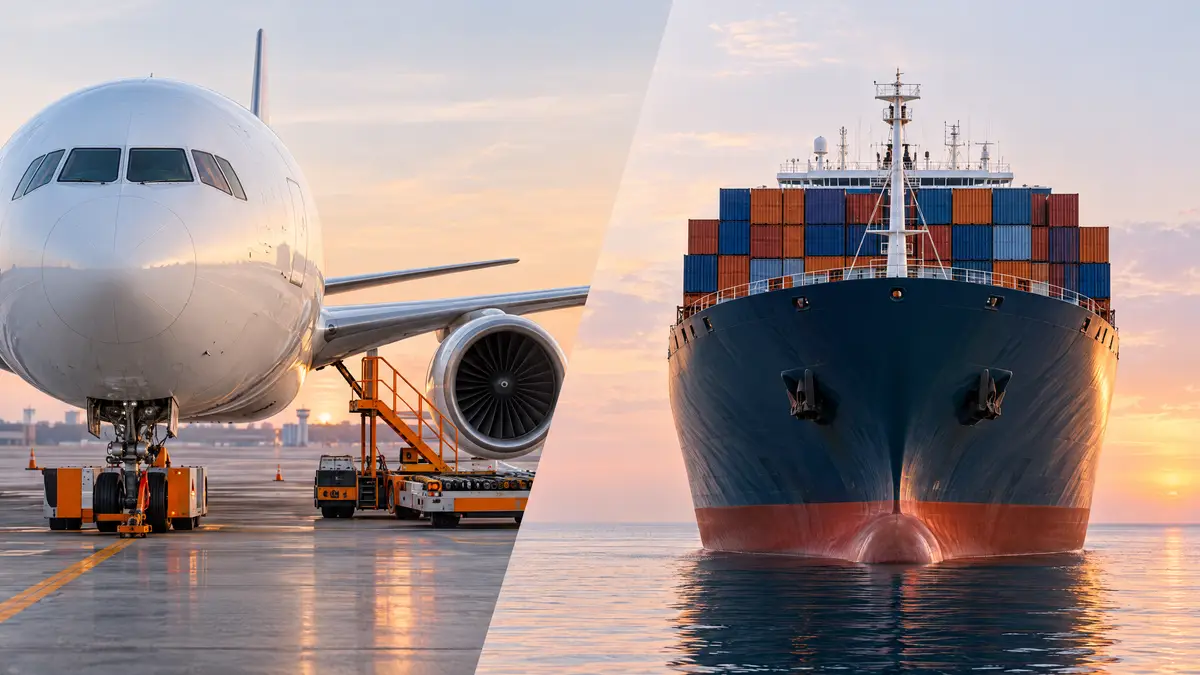
Choosing between air and ocean freight is one of the first decisions in any import. It moves total cost by 5% to 30% and total transit time by 7 to 45 days. So the question to ask is which mode fits this specific order, rather than which one is cheaper.
Quick comparison for 2026
| Variable | Consolidated air | Ocean LCL | Ocean FCL 20' | Express courier |
|---|---|---|---|---|
| Door-to-door time | 7 to 12 days | 30 to 45 days | 30 to 45 days | 4 to 7 days |
| Unit cost | USD 8 to 12 per kg | USD 80 to 120 per m3 | USD 2,800 to 4,500 per container | USD 18 to 30 per kg |
| Practical minimum | 20 to 50 kg | 0.5 m3 | 15 m3 | 1 to 30 kg |
| Real-time tracking | Yes | Limited | Yes | Yes |
| Damage risk | Low | Medium | Low | Low |
| Customs treatment | Standard | Standard | Standard | Simplified up to 4 kg |
When air freight makes sense
- Products with high value per kilo (electronics, jewelry, premium accessories).
- Launches or urgent restocks.
- Categories with a short shelf life (seasonal fashion, non-refrigerated perishables).
- When the cost of being out of stock is higher than the air freight premium.
- When the 25% rule applies: if air freight is under 25% of FOB, air almost always pays off.
When ocean freight makes sense
- Large volumes (a full FCL of 15 to 25 m3).
- Heavy or bulky products (textiles, footwear, hardware, cosmetics, ceramics).
- Inventory restocks on a tight margin.
- When you can plan 6 to 8 weeks ahead.
- For LCL: when the cargo fills between 0.5 and 8 m3.
Worked example: 200 units of headphones
An order of 200 units of Bluetooth headphones, FOB USD 8,000, total weight 80 kg, volume 0.4 m3.
| Item | Air | Ocean LCL |
|---|---|---|
| FOB | 8,000 | 8,000 |
| Freight | 720 | 48 |
| Total door-to-door time | 10 days | 38 days |
| Freight difference | +USD 672 | Baseline |
| Time difference | +28 days | Baseline |
If you sell the headphones at USD 80 each and move 100 units a month, the extra 28 days of waiting on ocean freight cost you a month of sales. That is USD 8,000 in potential revenue, which justifies paying USD 672 more in freight to get to market 28 days sooner.
Hybrid strategy
Many experienced importers run a hybrid strategy: 30% to 40% of the inventory arrives by air to start selling, and 60% to 70% arrives by sea 3 to 4 weeks later to restock. That way they get speed and low cost in the same operation.
Express courier: when it works and when it does not
Express courier (DHL, FedEx, UPS) is the fastest option and also the most expensive. It only makes sense for samples, first trial orders, urgent spare parts, or shipments that fit the 4x4 regime, the Ecuadorian courier category for parcels up to USD 400 and 4 kg with simplified taxation. Above 30 kg, courier rarely competes with consolidated air freight.