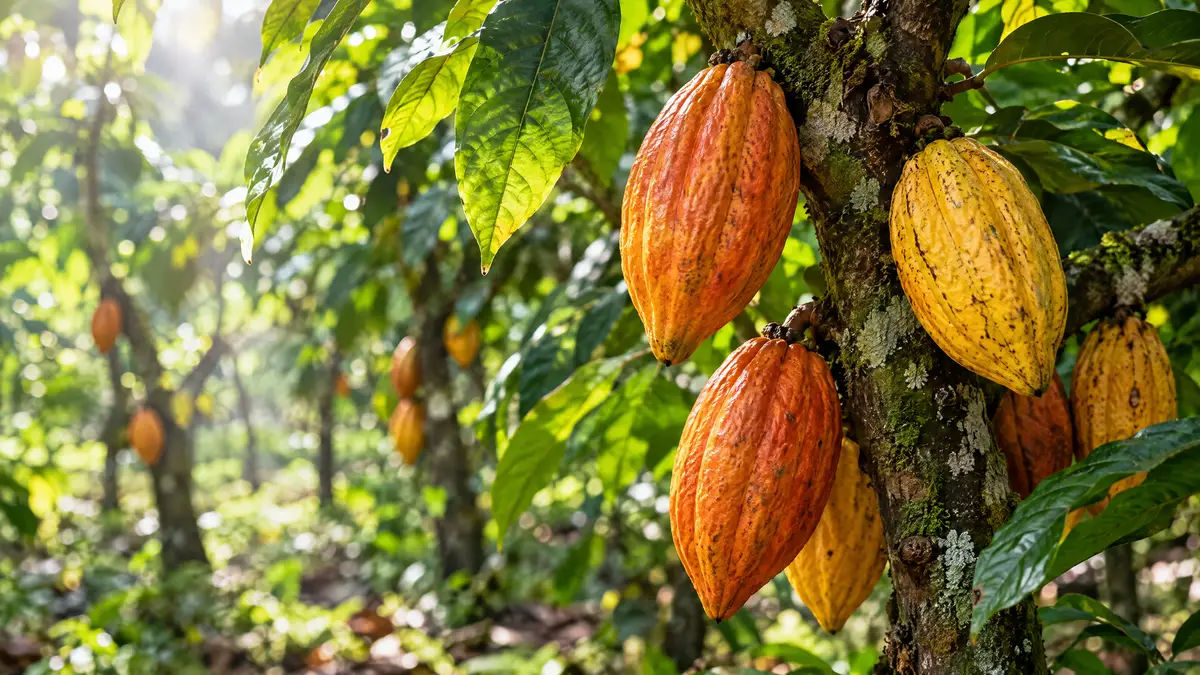
Ecuador is the global reference for fine flavor cacao, and if you buy or trade cacao beans you already know the quality case. What changed in 2026 is the paperwork behind that quality. A new European traceability rule now decides whether a shipment can even reach the port of Antwerp or Rotterdam, regardless of how good the bean tastes. This guide covers the markets, the tariff line, and the compliance check every buyer should run before confirming a purchase order.
Where Ecuadorian cacao is already going
The main buyers of Ecuadorian cacao are the United States, Malaysia, the Netherlands and Belgium. The Netherlands and Belgium function as the gateway into the European chocolate industry, most of the beans landing in Antwerp or Rotterdam get processed and redistributed across the rest of the continent. The international price has stabilized between 4000 and 4500 USD per ton in 2026, after a season of heavy volatility, which makes long term supply agreements more attractive than spot buying for manufacturers who need predictable input costs.
The EU tariff line, and why it favors Ecuador
Raw cacao beans already enter the European Union close to duty free under the bloc's general tariff for this raw material. The Ecuador-EU Multiparty Trade Agreement reinforces that condition and removes additional barriers on other Ecuadorian agricultural products, with an asymmetric structure: Ecuador gets immediate concessions while the EU phases down its own tariffs on European goods sold into Ecuador over a period of up to 17 years. For a buyer, that asymmetry is one of the reasons Ecuadorian origin has stayed price competitive against West African supply even as global cacao prices moved sharply.
The 2026 game changer: deforestation-free traceability
EU Regulation 2023/1115, known as EUDR, requires that any cacao entering the European Union can be traced back to the exact farm plot where it was grown, with geolocation coordinates, to prove it was not grown on land deforested after December 2020. Ecuador's agricultural authority, Agrocalidad, launched the GUIA registration system and the Mi finca mi huella campaign to register more than 100000 cacao and coffee producers. If the beans your supplier sells you come from an intermediary who cannot show a farm registered in GUIA with geolocation data, that lot cannot legally enter the EU under EUDR, no matter how clean the bean quality is on paper.
- Ask your supplier to confirm the origin farm is registered in Agrocalidad's GUIA system before you confirm the purchase order.
- Request the farm’s geolocation coordinates together with the commercial invoice, not after the shipment leaves port.
- Require the Agrocalidad phytosanitary certificate for each shipment, not a blanket certificate covering multiple lots.
- Request the certificate of origin needed to claim preferential tariff treatment under the Andean Community or the EU Multiparty Agreement, since without it your customs broker cannot apply the preferential rate on arrival.
HS code and how the product is presented
Raw or roasted cacao beans are classified under HS heading 1801. If you are buying semi processed cacao instead of raw beans, the code changes and so does the value add: cacao liquor falls under 1803, cacao butter under 1804, cacao powder under 1805 and chocolate under 1806. Buyers increasingly ask Ecuadorian suppliers to quote semi processed product instead of raw beans, since it usually improves the margin per kilo for the exporter and can simplify your own import classification if your country applies a lower duty to processed cacao than to raw beans.
Why Ecuadorian FOB pricing holds up
Drawback may allow a refund of duties paid on imported inputs incorporated into an exported product. For cacao, review requires identifying those inputs, the duties paid and their traceability. It is not guaranteed additional income or an automatic percentage of the export value.
ATLAS organizes the details of your cacao export so the team can review costs, origin and any potential duty refund. Share the product, volume and destination to prepare that review.